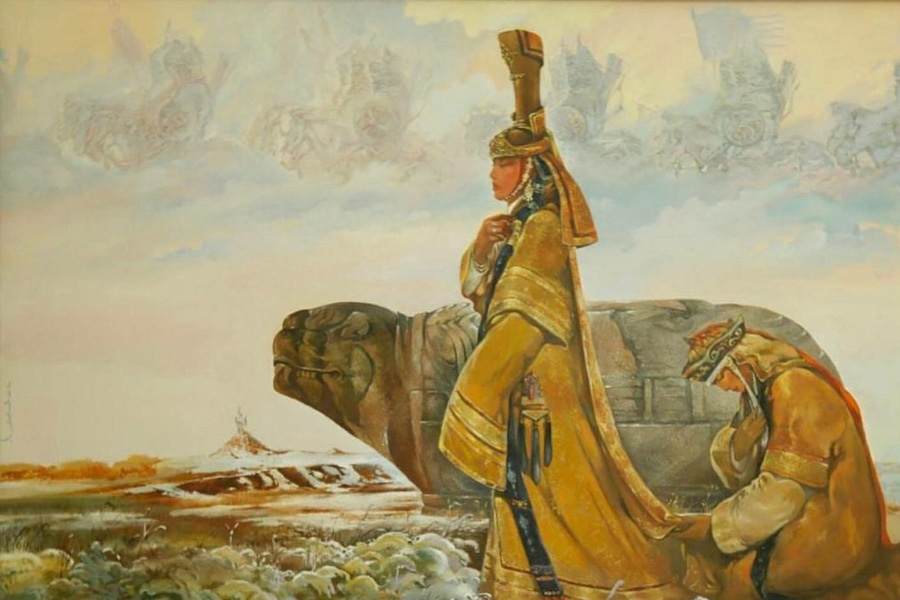
A Keraite Princess in a World Remade
When I trace the arc of the Mongol Empire, one figure keeps stepping out of the dust of the steppe with quiet, decisive grace: Sorghaghtani Beki. A princess of the Keraites and daughter of Jakha Gambhu, she married Tolui, the youngest son of Genghis Khan. From that union came four sons who would shape continents: Möngke, Kublai, Hulagu, and Ariq Böke. Yet Sorghaghtani was not merely a mother of kings. She was a strategist, an estate manager, a cultural bridge, and a stateswoman whose judgment guided the empire at pivotal moments. She lived her faith in the Church of the East while running a cosmopolitan household that drew on the talents of Christians, Buddhists, and Muslims alike. She died around 1252, but the political world she crafted endured for generations.
House of Tolui
After Tolui’s death in the early 1230s, Sorghaghtani took command of his ordo, the mobile household and economic engine that fueled status, patronage, and military power. In the Mongol political economy, an ordo was not merely a home; it was a roving capital under felt and sky, a treasury on the move. Whoever managed it commanded loyalty, horses, herds, craft specialists, and the streams of tribute that flowed from conquered lands. Sorghaghtani held this lifeline with both hands. She declined remarriage proposals that might dilute her sons’ inheritance. She stabilized the ordo, protected its personnel, and kept it productive. In the open spaces between rivers and mountain chains, her camp became a school of government.
The Four Sons
I like to imagine her as a conductor, training each son to play a different instrument.
Möngke, the eldest, was steady and disciplined. He would become Great Khan in 1251, presiding over a renewed central authority that held the sprawling empire together from Mongolia to the Mediterranean. Kublai learned to love administration and Chinese statecraft; he would later found the Yuan dynasty, translating steppe power into imperial governance with a sinicized style. Hulagu became the spear point in the west. He marched through Iran and Mesopotamia, took Baghdad in 1258, and established the Ilkhanate. Ariq Böke, the youngest, inherited his mother’s composure under pressure and later contested the imperial succession in a civil war with Kublai, a stark reminder that the family’s power was both magnificent and volatile.
Strategy, Alliances, and the 1251 Kurultai
Sorghaghtani’s genius lay in reading the family chessboard. She understood that power in the Mongol world hinged on consensus forged at kurultais, those great assemblies where princes negotiated legitimacy. She built relationships across the Genghisid lines, most notably with Batu of the Golden Horde, whose influence in the west could tip the balance in any imperial election. With gifts, tact, and careful timing, she assembled the coalition that secured Möngke’s election as Great Khan in 1251. That success rewired the empire. The Toluid branch moved to the center of policy, and her sons inherited a stage ready for their performances.
Faith and a Cosmopolitan Court
Sorghaghtani practiced the faith of the Church of the East. Her devotions did not narrow her vision; they broadened it. In her ordo, clerics might debate alongside scribes and merchants from different lands. She patronized religious figures, sponsored charitable works, and tolerated diverse practices in territories under Toluid sway. That approach strengthened her political hand. People joined her service not simply because she was powerful, but because her court felt workable, stable, and fair. In a world of caravans and campaigns, her spiritual charity softened edges that might otherwise cut.
Wealth and the Ordo
If you want to understand her wealth, stop looking for a ledger. Think instead of a living ecosystem. The ordo held pastures and herds, workshops for leather and textiles, caravans of trade goods, and skilled administrators who counted tribute and apportioned stipends. It funded armies and gift exchanges and marriages that cemented alliances. The language of coin is too thin for this. Her net worth was counted in people, horses, and the trust of powerful men who knew her gifts and feared her resolve. Chroniclers praised her generosity, and even rivals respected the breadth of her means.
Kin and Grandchildren
Her web of kin connected nearly every major power center of the age. Genghis Khan was her father in law. Batu, the formidable prince of the Jochid line, was her crucial ally. Through Hulagu, her grandchildren shaped the Ilkhanate in Iran, with Abaqa consolidating and governing after Hulagu’s death and Tekuder, known as Ahmad after his conversion to Islam, briefly taking the throne in a tumultuous turn. The family names read like river confluences, each feeding the next, each bend shaped by currents Sorghaghtani once set in motion.
Timeline Highlights
Her youth unfolded in the late 12th and early 13th centuries, among the Keraites, whose leaders had long interacted with Temujin’s Borjigin clan. She married Tolui in the season when alliances were the currency of survival. Her sons were born across the second and third decades of the 1200s, as the Mongol Empire expanded with astonishing force. Tolui’s death around 1232 shifted the axis of her life. From that moment she was more than a consort. She became the organ of continuity. Throughout the 1230s and 1240s, she steered the Toluid ordo, mentored her sons, brokered alliances, and held fast through storms that followed the deaths of earlier khans. In 1251, her strategy reached its summit when Möngke was elected Great Khan. Around 1252, after a brief illness, she died. Reports describe Christian rites and honors, a fitting farewell for a life that braided piety and power.
What She Taught Her Sons
Education, in her hands, was not abstract. It was stamina, literacy, languages, curiosity, and the knack for choosing the right adviser at the right time. Kublai’s appetite for Chinese texts and institutions, Möngke’s disciplined administration, Hulagu’s capacity to organize a long western campaign, even Ariq Böke’s claim to primal steppe legitimacy, all reflect a mother who trained them to operate on multiple fronts. She understood that the empire’s future would not be won by swords alone. It would be won by contracts, rituals, taxes, and the capacity to speak across cultures.
How I See Her Legacy
When I picture Sorghaghtani, I see a tent city lit at dusk, the ropes of each ger drawn taut like the lines of an instrument, the murmurs of counselors rising and falling. She is there at the center, not loud, not ceremonial, simply necessary. Her decisions shaped a century. Her household trained rulers who could govern as well as conquer. Her alliances pivoted the empire toward Toluid hands. Her faith made room for difference. In a world that valorized speed and shock, she excelled at steadiness.
FAQ
Who was Sorghaghtani Beki?
She was a Keraite princess who married Tolui, the youngest son of Genghis Khan, and became the mother of four major rulers and contenders: Möngke, Kublai, Hulagu, and Ariq Böke. After Tolui’s death, she managed his ordo and emerged as a central political figure in the empire.
What exactly was an ordo and why did it matter?
An ordo was the mobile household and administrative core of a Mongol elite. It housed the people, herds, workshops, treasuries, and archives that sustained power. Running the ordo meant controlling resources, personnel, and the patronage that secured loyalty.
How did Sorghaghtani help Möngke become Great Khan in 1251?
She built a coalition across Genghisid branches, cultivating allies like Batu of the Golden Horde, and maneuvered through the kurultai system with gifts, diplomacy, and impeccable timing. Her strategy delivered the votes and momentum that elevated Möngke.
Was Sorghaghtani Beki Christian?
Yes. She adhered to the Church of the East. Her faith informed a court culture known for tolerance and patronage of multiple religious communities, which broadened her political reach.
What did Sorghaghtani teach her sons that influenced their rule?
She emphasized literacy, administrative training, multilingual skill, and openness to skilled advisers from different traditions. Those habits shaped Möngke’s central administration, Kublai’s adaptation of Chinese governance, and Hulagu’s capacity to run far-flung campaigns.
Did Sorghaghtani lead armies in the field?
While not typically leading armies in direct battle, she commanded the resources that sustained them, issued orders within her domain, and influenced strategy through counsel and coalition building. Her power was executive and logistical, the kind that wins wars before they start.
How is she connected to the Ilkhanate in Iran?
Her son Hulagu founded the Ilkhanate after the western campaigns. Through him, her lineage continued with rulers like Abaqa and Tekuder, who shaped the politics of Iran and the Near East for decades.
What happened to her youngest son, Ariq Böke?
Ariq Böke was proclaimed Great Khan in 1260 and fought a civil war with Kublai. He eventually surrendered in 1264. His rise and fall reflect the enduring strength and inner tensions of the Toluid branch she had elevated.
When did Sorghaghtani die?
She died around 1252, shortly after Möngke’s accession. Accounts describe Christian rites and notable honors, consistent with her status and her lifelong religious practice.
Why does her name appear in different spellings?
Transliteration from Mongolian and Persian sources produces variants such as Sorqaqtani, Sorkaktani, or Sorghaghtani. All refer to the same historical figure, whose legacy is clearer than the spelling conventions that carry her name across languages.