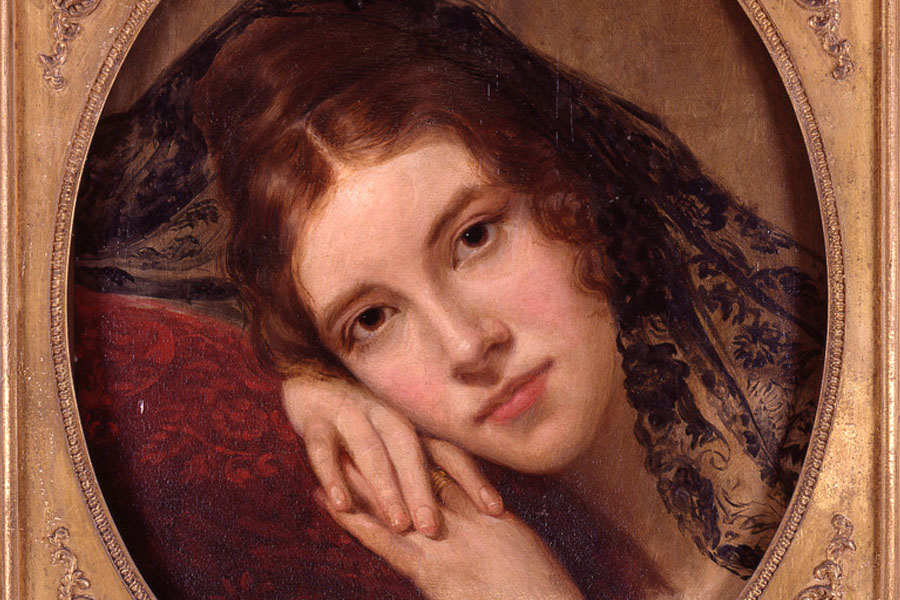
Basic Information
| Detail | Information |
|---|---|
| Full name | Frances Elizabeth “Fanny” Appleton Longfellow |
| Born | October 6, 1817 |
| Birthplace | Boston, Massachusetts |
| Died | July 10, 1861 |
| Age at death | 43 |
| Parents | Nathan Appleton and Maria Theresa Gold Appleton |
| Spouse | Henry Wadsworth Longfellow |
| Marriage | July 13, 1843 |
| Children | Six |
| Residence | Craigie House, Cambridge, Massachusetts |
| Occupations and interests | Diarist, amateur artist, art collector, correspondent, mother |
| Burial place | Mount Auburn Cemetery, Cambridge, Massachusetts |
A Childhood Shaped by Wealth and Loss
When I picture Fanny Appleton Longfellow growing up on Boston’s Beacon Hill, I see a young woman surrounded by privilege but never insulated from loss. Born on October 6, 1817, she belonged to one of New England’s wealthiest and most influential families. Her father, Nathan Appleton, was a merchant, banker, textile manufacturer, politician, and one of the driving figures behind the development of Lowell, Massachusetts.
The Appleton household at 39 Beacon Street was filled with books, conversation, travel, music, art, and the expectations that came with social position. Yet tragedy arrived early and repeatedly. Fanny lost her infant brother George William in 1827, her mother Maria Theresa to tuberculosis in 1833, her brother Charles Sedgwick Appleton in 1835, and cousin William Sullivan Appleton during the family’s European travels.
Her mother had been an unusually progressive influence. Maria Theresa came from a Pittsfield family that valued intellectual development for women, and Fanny received an education that was far more ambitious than what many girls of her generation experienced.
She studied grammar, geography, arithmetic, history, French, and Latin. She took drawing lessons and dancing lessons, read widely, and developed a particular enthusiasm for literature. Shakespeare, Shelley, Coleridge, Goethe, Fénelon, and Mary Wollstonecraft all entered her intellectual world.
I find it especially striking that Fanny’s education was not simply decorative. She developed the habits of observation and independent thought that would later appear in her journals, letters, drawings, and family chronicles.
The European Grand Tour
After Charles Appleton’s death in 1835, Nathan Appleton took his children and relatives on an extended European journey. For Fanny, then about 18, the trip became an enormous classroom without walls.
From 1835 to 1837, she traveled through France, Italy, Switzerland, Germany, Holland, and Britain. She visited museums, attended opera performances, observed royal ceremonies, explored historic sites, and filled journals with descriptions of the people and places around her.
But Fanny did not merely look. She drew.
Her European sketchbooks function almost like visual postcards from the Romantic era. Alpine mountains, glaciers, villages, ruins, coastlines, and classical monuments became subjects for her pencil and watercolor work. Her drawings were generally personal records rather than professional academic studies, but they reveal a practiced eye and a strong instinct for composition.
Switzerland became especially important because it was there, in 1836, that she met Henry Wadsworth Longfellow.
The encounter had the atmosphere of a literary romance before either person knew what the ending would be. Longfellow was already captivated. Fanny, however, was much less interested in romance. She offered friendship, while he offered something considerably deeper.
Fanny and Henry Longfellow
Longfellow courted for years.
Poetry, flowers, books, translations, and heartfelt greetings were delivered to Fanny. Still, she was reserved. Longfellow’s 1839 masterpiece Hyperion complicated their love tale.
The protagonist was based on Fanny, who didn’t like seeing their connection in fiction. Her harsh reaction suggested she thought the story disorganised and reflective of the author’s psyche.
They avoided each other for a while.
Everything changed in spring 1843.
In April and May, Fanny reunited with Henry and accepted his proposal. They married on July 13, 1843, at her father’s Beacon Street parlour. Fanny wore orange-blossom-decorated white muslin
Craigie House at 105 Brattle Street in Cambridge was Nathan Appleton’s extravagant wedding gift. The mansion was George Washington’s Revolutionary War headquarters. It became the Longfellow family hub.
A Marriage of Literature, Art, and Family
At Craigie House, Fanny became much more than the poet’s wife.
She was his intellectual companion, domestic collaborator, correspondent, artistic adviser, and family chronicler. When Henry’s eyes troubled him, she sometimes served as his scribe. She read aloud, discussed books and politics, exchanged observations about art, and maintained a lively correspondence with relatives and friends.
Her presence also found its way into his poetry.
Among the works associated with her influence are “The Arsenal at Springfield,” “The Old Clock on the Stairs,” and “The Evening Star.” Their marriage created a household where literature was not something kept behind glass. It was part of everyday life.
Craigie House became a gathering place for writers, artists, intellectuals, travelers, and members of Boston and Cambridge society. Fanny collected art and maintained her own artistic interests, even while raising children and managing a demanding household.
Her six children gave the house a new rhythm.
| Child | Born | Later life |
|---|---|---|
| Charles Appleton Longfellow | 1844 | Soldier, traveler, adventurer |
| Ernest Wadsworth Longfellow | 1845 | Artist |
| Frances “Fanny” Longfellow | 1847 | Died in infancy in 1848 |
| Alice Mary Longfellow | 1850 | Education advocate and preservationist |
| Edith Longfellow Dana | 1853 | Married Richard Henry Dana III |
| Anne Allegra “Annie” Longfellow Thorp | 1855 | Education advocate and mother |
Fanny as a Mother
Fanny was deeply involved in her children’s education. Geography, reading, religion, manners, and curiosity all formed part of the informal curriculum at Craigie House.
Her daughter Alice Mary became particularly associated with the family home and later helped preserve its legacy. Edith married Richard Henry Dana III, linking the Longfellow family to another prominent New England literary family. Annie, the youngest, remained especially close to her father after Fanny’s death and later pursued education at Harvard Annex and Newnham College in Cambridge.
Fanny’s daughter Frances, born in 1847, had a particularly unusual birth. Ether was administered during the delivery, an event remembered as an important milestone in the history of obstetric anesthesia. Tragically, the little girl died in 1848.
The loss devastated her mother.
These family experiences help explain why Fanny’s journals and domestic writings are so valuable. She recorded ordinary life with the awareness that ordinary life could disappear without warning.
The Woman Behind the Sketchbooks
Fanny’s sketchbooks reveal a side of her identity that can easily disappear behind the famous name of her husband.
I find the drawings fascinating precisely because they were not created as a career strategy. They were the work of a young woman who wanted to see, remember, and preserve what she encountered.
Her Swiss drawings include mountain scenery, glaciers, villages, bridges, water, and distant peaks. Some Italian sketches capture the Naples region, classical ruins, and Mount Vesuvius. One drawing from Pompeii carries a note indicating that she began it there but was stopped by a guard.
Another particularly intriguing image of Castel dell’Ovo appears to include a small self-portrait of a young woman with ringlets, apparently sketching the landscape.
The visual diary also connects directly with Fanny’s romance with Longfellow. One of her sketchbooks was presented to Henry on their wedding day in 1843. Its inscription referred to the characters Mary Ashburton and Paul Flemming from Hyperion, turning the object into a private relic of a complicated courtship.
Her European journals broaden the picture. They record opera, architecture, social encounters, museums, travel difficulties, famous sights, and the small details that make historical travel feel human rather than ceremonial.
The Appleton Family
Fanny’s family connections stretched across a remarkable network of nineteenth century New England culture.
Her older brother Thomas Gold Appleton was a writer, painter, traveler, art patron, and celebrated wit. He became famous for the quip, “Good Americans, when they die, go to Paris.”
Her sister Mary Appleton married Robert James Mackintosh, a British colonial official, and lived in England and the West Indies. The siblings remained connected through correspondence despite the distance.
Nathan Appleton’s later marriage to Harriot Coffin Sumner created Fanny’s half-siblings William Sumner Appleton, Harriot Sumner Appleton Curtis, and Nathan Appleton Jr.
At the center of the family stood Nathan himself, a formidable businessman whose fortune helped finance the education, travel, artistic interests, and comfortable lives of his children. His gift of Craigie House effectively placed Fanny and Henry at the center of a historic Cambridge residence.
A Tragic Final Day
Fanny’s life ended suddenly on July 9, 1861.
She was sealing packets containing her children’s hair with hot wax when her light cotton dress caught fire. She ran toward Henry. He attempted to put out the flames, using a rug and his own body, but suffered severe burns to his face, hands, and arms.
Fanny died the following morning, July 10, at only 43 years old.
The timing was painfully symbolic. Her funeral took place on July 13, the eighteenth anniversary of her marriage, although Henry was too badly injured to attend. She was buried at Mount Auburn Cemetery.
Nathan Appleton died only four days after his daughter.
Henry never recovered emotionally in the ordinary sense of the word. He eventually grew a beard to conceal the scars left by the fire, and years later he wrote the haunting sonnet “The Cross of Snow,” inspired by the memory of Fanny.
The Children After Fanny
After her death, Henry raised the children with help from relatives and governesses. The family remained closely connected to Craigie House, and the three daughters in particular became important keepers of their parents’ memory.
Alice Mary devoted much of her later life to education, historic preservation, and the family’s literary heritage. Edith lived nearby on Brattle Street with her husband and children. Annie eventually married Joseph Gilbert Thorp Jr. and raised five daughters.
In this way, Fanny’s influence continued through the family even though she died while her children were still young.
Fanny Appleton Longfellow’s Legacy
Fanny’s legacy spans several universes.
She was the daughter of a wealthy businessman, wife of a famous American poet, and mother of six. But those designations alone diminish her tale.
Her notebooks display excellent observation. A talented amateur, her drawings show. She writes with interest and discussion. Her domestic function shows an intellectual companion who participated in one of America’s most famous nineteenth-century writers’ cultural life.
Survivor sketchbooks may provide the most personal proof. Before she became the mistress of Craigie House and the wife of Longfellow, she was a young lady traveling around Europe with a pencil in her hand, documenting glaciers, ruins, mountains, villages, and parts of a world that she knew she may never see in just the same way again.
Family Timeline
| Year | Event |
|---|---|
| 1817 | Frances Elizabeth Appleton is born in Boston |
| 1827 | Brother George William dies in infancy |
| 1833 | Her mother Maria Theresa dies |
| 1835 | Brother Charles dies of tuberculosis |
| 1835 to 1837 | Fanny travels through Europe with her family |
| 1836 | She meets Henry Longfellow in Switzerland |
| 1839 | Hyperion is published |
| 1843 | Fanny and Henry reconcile and marry |
| 1844 | Charles Appleton Longfellow is born |
| 1845 | Ernest Wadsworth Longfellow is born |
| 1847 | Frances Longfellow is born |
| 1848 | Frances dies in infancy |
| 1850 | Alice Mary Longfellow is born |
| 1853 | Edith Longfellow is born |
| 1855 | Anne Allegra Longfellow is born |
| 1861 | Fanny dies after the fire at Craigie House |
FAQ
Who was Fanny Appleton Longfellow?
Fanny Appleton Longfellow was an American diarist, amateur artist, art collector, and cultural figure who became the second wife of poet Henry Wadsworth Longfellow. She was also the mother of six children and an important intellectual partner in her husband’s household.
When did Fanny Appleton Longfellow marry Henry Longfellow?
Fanny and Henry married on July 13, 1843, at her father’s home on Beacon Street in Boston. Nathan Appleton gave the couple Craigie House in Cambridge as a wedding gift.
How many children did Fanny Appleton Longfellow have?
Fanny and Henry had six children: Charles, Ernest, Frances, Alice, Edith, and Anne Allegra. Their daughter Frances died in infancy.
What happened to Fanny Appleton Longfellow?
On July 9, 1861, her dress caught fire while she was sealing packets of her children’s hair with hot wax. She suffered severe burns and died the following morning.
Where is Fanny Appleton Longfellow buried?
Fanny is buried at Mount Auburn Cemetery in Cambridge, Massachusetts, where her grave remains associated with the Longfellow family history.
What were Fanny Appleton Longfellow’s sketchbooks about?
Her sketchbooks contain pencil and watercolor drawings from her travels, particularly scenes from Switzerland and Italy. They include mountains, glaciers, villages, ruins, coastlines, and architectural subjects.
Did Fanny Appleton Longfellow have a career?
She did not have a conventional paid career, but she was highly active intellectually and artistically. Her work as a diarist, correspondent, amateur artist, art collector, mother, and literary companion formed the center of her adult life.
What was Fanny’s relationship with Henry Longfellow like?
Their relationship began with a lengthy courtship in which Henry was deeply interested while Fanny initially preferred friendship. After their reconciliation in 1843, they developed an affectionate and intellectually rich marriage.
Who was Nathan Appleton?
Nathan Appleton was Fanny’s father and a wealthy Boston merchant, banker, textile manufacturer, and politician. He was also an important figure in the development of Lowell’s textile industry and gave Craigie House to Fanny and Henry as a wedding present.
Why are Fanny’s European journals important?
Her journals provide a detailed first person record of nineteenth century travel, art, architecture, social life, and family experience. Together with her drawings, they preserve an unusually vivid picture of a privileged American woman’s intellectual life before marriage.