A young face in the earliest moving pictures
I often return to a tiny patch of lawn in Roundhay, where leaves flicker and sunlight turns people into ghosts with weight. In the short film known as Roundhay Garden Scene, filmed in October 1888 at Oakwood Grange near Leeds, a young man moves through the frame with the unstated ease of family life. That young man is Adolphe Le Prince, son of the experimental filmmaker Louis Le Prince. The scene lasts only seconds, yet it feels like a door opening, a turning of time into motion. It shows a family at play, and Adolphe is right there, forever present. Some accounts associate him with another brief experiment from his father, the Accordion Player, a glimpse of performance folded into the new language of moving images. These fragments do not talk, but I hear them anyway.
Roots in Leeds and the Whitley circle
Adolphe, christened Louis Adolphe W. Le Prince, was born around 1872 in Hunslet, Leeds. His life unfolded in the orbit of two families who were both local and international. On one side stood his father, Louis Aimé Augustin Le Prince, French born, painter and inventor, a man who chased images until they ran under their own power. On the other side stood his mother, Sarah Elizabeth Whitley, rooted in the Whitley family of Oakwood Grange, whose grounds became stages for those early films. Adolphe grew up among siblings, with brothers Joseph Augustine and Leon Fernand consistently listed in family records. A sister named Gabriella Mary appears in some genealogies. The ordinary pulse of a Leeds household, its addresses and routines, merges with the extraordinary fact of being captured in motion before motion pictures had a name that stuck.
The father who vanished
Every family story has a shadow, and this one is shaped like a train carriage. In 1890, Louis Le Prince boarded a train in France and did not arrive. He disappeared, leaving behind reels, cameras, and a household that had learned to watch daylight through a lens. I imagine Adolphe in that moment, a young man who had been filmed at play, now watching the world for a clue. The disappearance gathered theories and doubts. It also turned the Le Prince children into caretakers of a legacy that was still fragile. When a pioneer vanishes, the family inherits not only grief but also a strange kind of stewardship. Ideas require guardians. So do questions.
Courtroom echoes in 1898
Years later, in 1898, Adolphe stepped into a courtroom to testify in litigation that sought to define the invention of motion pictures. Edison vs. American Mutoscope was more than a legal case. It was a struggle over memory and priority, a contest about who shaped the way images learned to move. Adolphe gave evidence about his father’s work, becoming a living link between the experiments at Oakwood Grange and the industrial contests that tried to draw borders around innovation. I can see him there, describing devices and dates, trying to summon presence from absence. Testimony is an art of rebuilding, sentence by sentence. In that room, he was speaking not only for his father, but for a version of history that recognizes the many hands that pushed cinema forward.
A summer that ended in silence
In August 1901, Adolphe was found dead on Fire Island, New York, near Point O’Woods. Reports describe a gunshot death. Some later accounts call it suicide, while others avoid certainty. The sea can make any ending feel remote, even when the facts sit plainly on a page. I do not claim to know what happened in those final hours. I do feel the weight of it, and I think about the family who once danced on a lawn, now facing another loss that resists explanation. These conflicting narratives are a reminder that history is a chorus, sometimes dissonant. For Adolphe, it was a quiet close to a life connected to voices that did not survive on their own, but whose images did.
Why his story still matters
Adolphe’s life is not filled with public accolades or long lists of achievements. It is a path through ordinary family roles, one bright courtroom appearance, and a few seconds of film that changed everything. Yet those seconds resonate. Adolphe is a witness standing at the edge of a threshold, where pictures stop being still, and time begins to move. Through him, we see the human side of invention. We see a son, a brother, an early subject turned into an accidental symbol. His story matters because film history is not only about machines and patents. It is also about families, friendships, and the ways people reach for each other when the future arrives.
The Le Prince family in motion
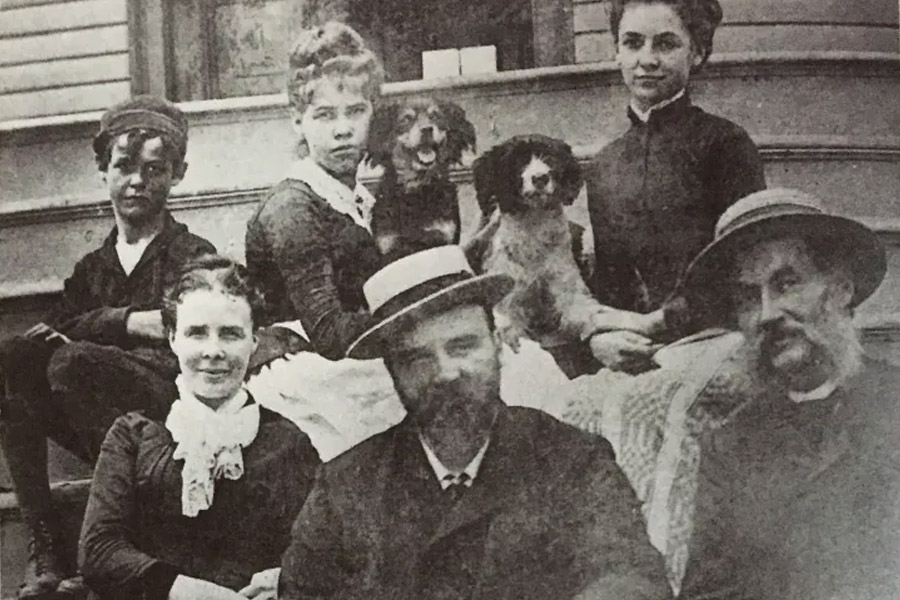
When I trace the Le Prince story, I follow a constellation. At its center stands Louis, the father who built cameras and coaxed frames into flow. Beside him stands Sarah Elizabeth, whose Roundhay ties grounded the experiments on familiar ground. Around them move the children, Adolphe among them, Joseph Augustine and Leon Fernand, with other names appearing in some trees and archives. Their home life had rhythms, as all families do. School terms. The hum of crafts and lessons. Afternoons that turn to light in the garden. Some of those hours were recorded on film, which means they are both ephemeral and permanent. The family’s private world became public memory, a paradox that cinema has taught us to accept.
Leeds, legacy, and the touch of place
Place matters in this story. Leeds is not merely a backdrop. It is a partner, almost a producer, lending gardens and granges to invention. Oakwood Grange offered a patch of earth where experiments could unfold without ceremony. The city’s industrial pulse matched the experimental drive of the Le Prince household. When I walk through Leeds today, I imagine a boy crossing a lawn, unaware that the future is tracing his steps, frame by frame. Even without dialogue, the early films speak. They say a family lived here, dreamed here, and carried those dreams across continents. They say invention has a local address, even when its influence becomes global.
The meaning of testimony
Adolphe’s 1898 testimony is memorable for its precision, not its drama. The son desired a fair record. Results were out of his control. He didn’t change everything. He contributed a steady, informed voice to a challenging conversation. He reminds me that history is not just inventions or attention-grabbing. Who speaks, makes notes, and holds the line when the story veers away is also important. Adolphe did. His family memories became public proof.
A face among firsts
To watch Roundhay Garden Scene is to see firstness disguised as everyday life. Adolphe moves, turns, gestures. The camera captures a hint of character, then lets it go. He is one of the earliest people ever filmed, a claim that sounds grand until you look at the frame and see how modest it is. That modesty is its power. Film did not begin with epics or declarations. It began with families on grass, with sunlight and laughter. Adolphe’s presence reminds me that cinema was human from the start. In that sense, he is more than a witness. He is a participant in the spark.
FAQ
Who was Adolphe Le Prince?
Adolphe Le Prince was the son of the early motion picture pioneer Louis Le Prince and Sarah Elizabeth Whitley. He appeared in his father’s experimental films, including the Roundhay Garden Scene, and later testified in a major legal case about the invention of motion pictures.
Where and when was Adolphe born?
He was born around 1872 in Hunslet, part of Leeds, Yorkshire. Records from family sources and local censuses place him in the Leeds household with his parents and siblings.
What happened to his father, Louis Le Prince?
Louis Le Prince disappeared in France in 1890 after boarding a train. The case remains unresolved. His disappearance transformed a technical story into a family mystery and prompted later efforts by the family, including Adolphe, to protect and promote his legacy.
What role did Adolphe play in the 1898 legal case?
He gave testimony in the Edison vs. American Mutoscope litigation, providing evidence about his father’s pioneering work with moving pictures. His role was that of a witness who could connect the courtroom to early experiments in Leeds.
How did Adolphe die?
He died on Fire Island in New York in August 1901, with reports describing a gunshot death. Some accounts present it as suicide, while others emphasize uncertainty about the exact circumstances.
Who were his siblings and close family?
Adolphe’s parents were Louis Aimé Augustin Le Prince and Sarah Elizabeth Whitley. Siblings consistently cited include Joseph Augustine and Leon Fernand. A sister named Gabriella Mary appears in some genealogies. The wider Whitley family of Oakwood Grange provided both personal roots and the setting for the early films.